German Wagon
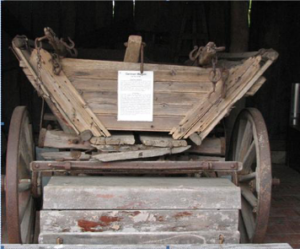 Bought to Australia by the Fourter family in the mid 19th century and used by them on their Model Farm at Nethercote near Eden.
The Fourter German Wagon is believed to have been brought to Australia from Germany during the mid-19th century by the immigrant Fourter family. It was used by them on their Model Farm property at Nethercote near Eden for many years before being stored in a shed on the same property. It was donated to the Bega Pioneers Museum by Peter Ubrihien in December 2002.
Wagons as built by or for the early German settlers remained basically the same as those illustrated in an 1817 publication that showed a wagon conveying wine by the early Romans, hence this represents a design used by the German peoples for agricultural purposes for upwards of two thousand years.
Found on many farms worked by German pioneers throughout New South Wales, South Australia and Queensland, the German wagon was used for a multitude of purposes – to transport produce, timber, household goods, farm equipment and passengers. They were also sometimes covered with fabric for sleeping quarters while traveling or until housing could be constructed.
Blue and red were a typical colour scheme for traditional German wagons. This evolved from the combination first used in early Lutheran Churches. Blue symbolised heavenly love and the colour of truth, and red the colour of blood or fire representing confession as well as the Holy Spirit. Over the years, these colours were transferred to the German wagon, with the wheels often painted red and the body blue.