Bega’s First Ambulance / Trad Wagon
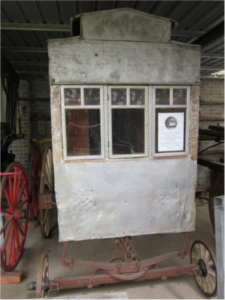
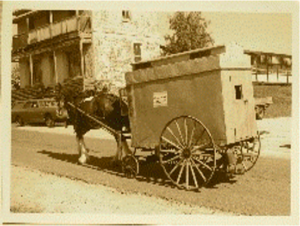
Built in 1906 after a fatal accident in 1902.
It had a short life as an ambulance and then became a hawkers wagon owned by George Trad
Originally built as a horse-drawn ambulance and then later converted to a hawker’s wagon, this vehicle has a lengthy and important historic association with the Bega district.
The need for an ambulance to transport the ill or injured was being felt locally by the turn of the 20th century. This was highlighted by a shocking coach accident in Bega’s main street in March 1902, when one passenger, Roger Heffernan of Moggendoura, was killed and another, Nurse Allen of Bega, had both her legs broken. The Southern Star reported “Last Saturday’s frightful coach accident clearly illustrates the necessity of establishing an Ambulance Corps in Bega. The wounded had to be lifted up bodily and carried away and the torture Miss Allen endured while she was being carried was something frightful. If ambulance stretchers had been provided, the unfortunate young lady would have avoided the pain of being carried by her broken legs. It is to be hoped that provision will be made for future emergencies.“
As with many rural communities however, it was a case of self help. The township of Bega had secured the district’s first horse-drawn ambulance in 1906 and in 1914, Cobargo’s was built at a cost of £140, the funds being raised through the sale of six penny tickets.
Both vehicles were manufactured by renowned Bega coach building firm Whyman and Brooks. In April 1906 the Southern Star reported that “Messrs. Whyman and Brooks have the order for the Bega Ambulance in hand and the vehicle will be constructed on the same principle as the one which was awarded first prize at Geelong a year or so ago. It is satisfactory to know that the work is being done locally.” In March 1914, the Bega Standard noted that “Messrs. Whyman and Brooks have completed an up to date and well-equipped ambulance to do service in the town of Cobargo. The vehicle will be a non-competitive exhibit at the Bega Show and is well worth inspection.“
Bega-born Robert Whyman had learnt the coach building trade at Commens and McDonald’s establishment before purchasing their business in partnership with George Brooks. In May 1900, the pair had an extensive new premises built in Auckland Street, Bega.
According to Jack Burgess of Bega, Cobargo’s horse-ambulance was first used to transport a patient from that town to Bermagui for steamer transport to Sydney to undergo an amputation.
With the arrival of motorised vehicles soon after it’s completion, the Cobargo horse-drawn ambulance only remained in use for its original purpose until 1915. It was then placed in a shed at the Cobargo School of Arts, where it reputedly became a favourite meeting place for young local couples.
Its second incarnation began when the vehicle was purchased in the 1920s by local “Syrian” hawker George Trad to transport and sell his wares around the district.Reportedly born in about 1903, he had been christened Assif after his grandfather, but preferred the alternative “George” after his father. Although usually referred to as “Syrian” or “Assyrian” there is some likelihood that George Trad was Lebanese, little distinction being made between the various Middle-Eastern cultural groups before the existence of modern National boundaries. According to information provided by his nephew [?], George was born in a town called Barhalioun in North Lebanon.
It is not known exactly when George commenced his hawking trade, although as hawkers had to be licensed, the Register of applications for auctioneers’, hawkers’ and other licenses at State Records NSW could clarify these details. However, according to Mrs. Lucas of Brogo, her mother remembered buying needles and pins from him in Eden during the 1920s, when he carried his wares in a basket on his head “in the traditional way”.
After purchasing the former ambulance, Cobargo blacksmith Henry Brown converted the vehicle from a two to a single horse vehicle. Rows of shelving made from recycled packing boxes were also installed inside to hold Trad’s merchandise.He became well-known on the roadways, tracks and properties of the Bega Valley and as far south as Kiah beyond Eden through to Nowra in the north. As horse drawn vehicles gradually disappeared from the local roads, the characteristic clip-clop of hooves signaled to residents when George was nearby.
Like many people from different cultural and ethnic backgrounds, George was not immune to the ignorance and racism of the times, despite his well known and recognised presence. According to Norma and Jeff Green, children spoke uncharitably of him as the “Ass-Ass-Assyrian” and some were known to taunt him by throwing stones at his wagon. The dents evident on the exterior aluminium cladding of the vehicle are said to be the result of these incidents.
George reportedly carried a small concertina with him for entertainment, joining other musicians at his various stops. Mr. Holdsworth at Niagara, Kameruka, would accompany him with his large accordion to entertain the family after which they would indulge in cribbage until the early hours.
George also had a number of dogs over the years that accompanied him on his travels. One, a shorthaired terrier named “Tinker”, slept on a makeshift bed on the swinging platform under the wagon.
In February 1950 George was brought before the Bega Court charged with ill-treating his horse which was reportedly in a starving condition. Fined £10, he was ordered by the Magistrate to shoot the animal, although it received a reprieve and was placed in a good paddock to recover. It is not recorded whether the animal recovered sufficiently to resume its duties or if George purchased a new horse, but it eventually died in the late 1950s.
As with so many other hawkers, George slept in the tiny cart during his trips throughout the region. He was a common site around the area and local newspapers tracked his movements from the 1930s. From the late 1950s George stayed at the Lucas family’s Brogo farm until he came ill in 1961. After being hospitalised at Bega, he moved to Sydney to live with his brother Elias and family until his death in 1964.
After his departure from the district, George Trad’s cart was abandoned in the old Balmain Brother’s parking lot in Peden Street, Bega, until being impounded by the local police.
In 1962, then president of the Bega Valley Historical Society, Sister Bernice Smith purchased the vehicle from the police impound for £10, as confirmed by the historical society minutes. After remaining in her Carp Street yard for several years, the former ambulance and hawker’s van made its final journey as part of the grand procession in April 1977 to mark the official opening of the Bega Pioneers’ Museum. Drawn by Chris Steele’s Clydesdale “Big Jane” and driven by Arthur Tygh, the cart was put in place in the museum grounds, where it remains on display to the present day (2014)
In April 2002, a panel of religious pictures were removed for repair from the interior of George Trad’s wagon, revealing a stash of eight tobacco tins containing bundles of £10 notes. These were subsequently stored at the museum and some remain in the collection today (2014), although others were sold or used as raffle prizes.